 Low Back Pain Coach
Home / Why this app exists
Why this app exists
If you have tried the doctor, the chiropractor, the PT sheets and the YouTube stretches and back pain still takes up your week, the person who built Low Back Pain Coach has been there. This page is what he tried, what he did next, and what to know before you try it.
Ten years of back pain
He had low back pain for about ten years, from his early twenties into his thirties.
He tried several treatments and exercise routines. A doctor prescribed anti-inflammatories. Chiropractors offered weekly adjustments. Physical therapy helped more than anything else, but it was expensive, and the exercises came on a printed sheet and never got harder. Dry needling, YouTube stretch routines and the McGill Big 3 did not change much for him. If you have done the Big 3 and want the options, see McGill Big 3 alternatives.
An MRI showed disc degeneration at two levels. He later learned that findings like that are common in people with no pain at all. The MRI guide has the sources.
What he did
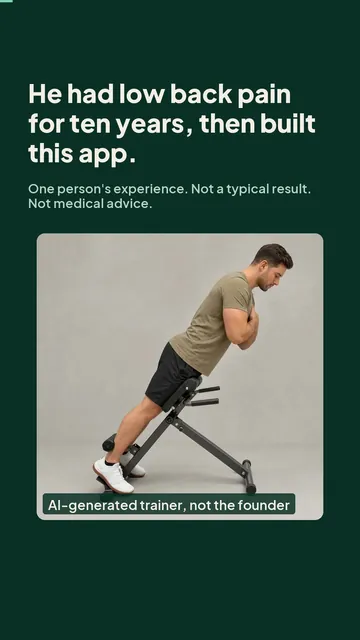
A slow back-extension progression on a 45° bench. He started with a few bodyweight reps. Over about eight months he worked up to loaded sets. He did a little, checked how his back felt the next day, and only then did a little more. His pain went down a lot.
What he believes about why
He believes long-term back pain is partly physical and partly a spiral of avoidance. You protect your back because it hurts, it gets weaker from not being used, and the weakness and the worry keep the pain going. He wanted a way to build strength slowly and check the next day.
That is his explanation of his own back, not a finding. The fear-avoidance guide covers what the research says about fear of movement and pain.
Everyone's back is different, so results vary and aren't guaranteed. A Cochrane review of 249 trials found that exercise programs for chronic low back pain reduced pain on average compared with no treatment, usual care or placebo, by about 15 points on a 100-point scale at the first follow-up (closest to 3 months), and improved day-to-day function by a smaller amount. This exact progression has not been tested in a trial. The app is not medical treatment; talk to your doctor before starting a new exercise program, and stop and get help if you have any of the warning signs listed in the app.
What to know before you try it
His story is one person’s. No trial has tested this exact progression. Research supports exercise in general for chronic low back pain (what the guidelines say). He has no medical or physical-therapy training. The app is a paid product made and sold by the person in this story, so weigh the story with that in mind.
The app
Low Back Pain Coach is built around that progression, with your daily pain log setting the next session. It needs a 45-degree back-extension bench, at home or at a gym, and starts you on floor work until you have one. What it does and what it costs, or how the progression works.


Your first guided session is free. Then $59.99 a year or $9.99 a month, renewing until you cancel, with a 7-day free trial for eligible new subscribers. US prices. iPhone and Android.
If back pain has taken over your life
It may be worth asking your doctor whether a gradual strength program could be part of your plan. The appointment questions page has a list to bring.
Go to emergency care now if
- You have new numbness, tingling or a change in feeling around the groin, inner thighs, genitals or anus (the saddle area), or when you wipe.
- You have new trouble getting or keeping an erection, cannot orgasm, or feel a change during sex.
- You have new bladder or bowel changes: trouble starting or stopping pee, a weak stream, not feeling when you need to go, or leaking pee or poo.
- You have new pain, tingling, numbness or weakness in both legs.
- A leg or foot is getting weaker: you trip, or the foot slaps down.
- The back pain started after a recent serious accident, like a car crash or a bad fall.
Stop and see a clinician today if:
- You have other new weakness or numbness in one leg or foot.
- You have fever or chills along with the back pain.
- The pain is new after a recent smaller fall or knock.
- You have lost weight without trying, or you have a history of cancer.
- The pain is getting worse fast.
- The pain is constant at rest, worse at night, and does not change when you move.
Use urgent care if you cannot get an appointment today.
Pain in your legs during or after the exercise means stop the extension work and do not add load. If you had surgery or an injury in the past few months, do not start until a clinician has checked it and you have finished the recovery plan they set. More on each of these.
Published by Scrolling Is Evil LLC.